Tampa General Hospital
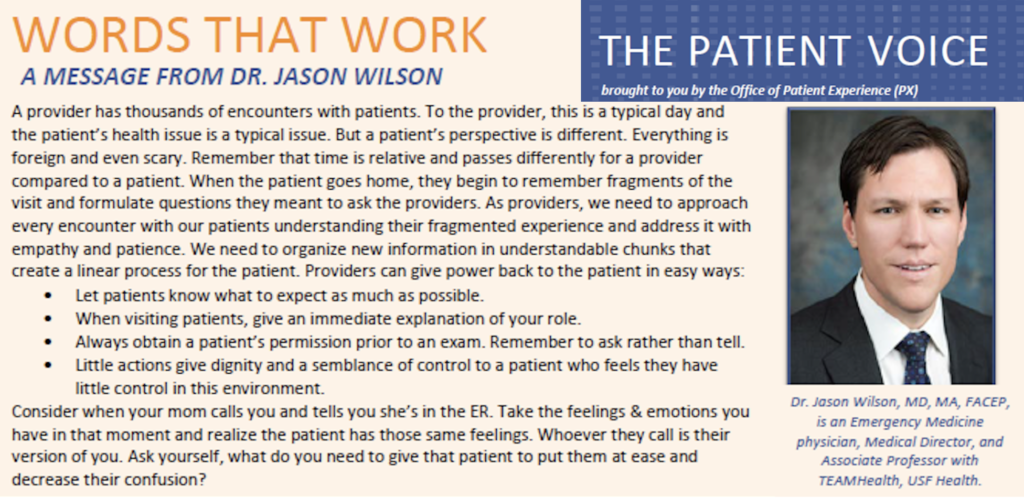
“A provider has thousands of encounters with patients. To the provider, this is a typical day and the patient’s health issue is a typical issue. But a patient’s perspective is different. Everything is foreign and even scary. Remember that time is relative and passes differently for a provider compared to a patient. When a patient goes home, they begin to remember fragments of the visit and formulate questions they meant to ask the providers. As a provider, we need to approach every encounter with our patients understanding their fragmented experience and address it with empathy and patience. We need organize new information in understandable chunks that create a linear process for the patient. Providers can give power back to the patient in a number of ways.
- Let patients know what to expect as much as possible
- When visiting patients, give an immediate explanation of your role
- Always obtain a patient’s permission prior to exam. Remember to ask rather than tell.
- Little actions give dignity and a semblance of control to a patient who feels they have little control in this environment
Consider when your mom calls you and tells you she’s in the ER. Take the feelings and emotions you have in that moment and realize the patient has those same feelings. Whoever they call is their version of you. Ask yourself, what do you need to give the patient to put them at ease and decrease their confusion?”
-Jason Wilson, MD
