Informed consent(ER)

AI, diagnosis and the acute care encounter

There is a role for AI augmentation of the acute clinical encounter, and this manuscript from Science does demonstrate that potential tools are improving. However, the headlines (AI beats doctors) are of course splashier than reality — this was not a prospective ED-based study measuring EM physician performance, and in any case, diagnosis is rarely the crux of the problem we are trying to solve during the acute encounter.

This is a dataset evaluation, with both AI and physicians generating differentials offline at predefined touchpoints. No head-to-head, real-time, in-the-moment EM workflow was tested. While the study makes claims about EM, it is critical to note that the comparator physicians were internal medicine attendings — not emergency medicine. If the implication is that this informs ED triage and how precision evolves as a case unfolds, the comparator specialty matters. EM clinicians reason differently because the task is different.

The ED encounter is largely about ruling out dangerous disease (ACS, PE, SAH, sepsis, stroke), shaped by social and system factors as much as pathophysiology. While House made it seem like “the diagnosis” is the climax of medicine, in real EM practice, the rule-out — and then care coordination — is usually the work.

Physician-in-the-loop LLMs will likely help. As ED disposition becomes more granular — admit vs. transition clinic vs. hospital-at-home vs. tele-coordination — earlier, more precise diagnostic support could meaningfully change patient experience and care pathways. That said, we already have RCT-level evidence that imaging AI improves diagnosis, and even those tools remain poorly implemented secondary to infrastructure silos in healthcare delivery and reimbursement.
New Publication!

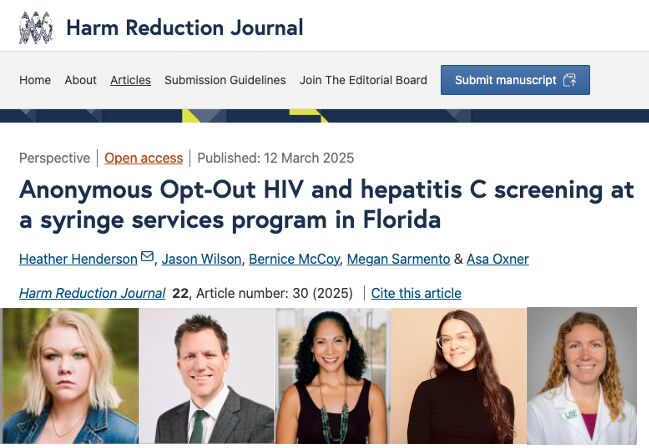
A new paper out of USF EM, led by Heather Henderson, PhD, CAP, CRPS, has been published in Harm Reduction Journal! The manuscript highlights an opt-out screening model at a syringe services program (SSP), leading to higher participation rates, earlier detection, & improved linkage to care for people at risk of HIV & HCV. These findings emphasize how routine, anonymous screening can be a scalable model for harm reduction programs nationwide. The team includes Jason W. Wilson, MD, PhD, CPE, FACEP, Bernice McCoy, PhD, MPH, USF anthropology PhD candidate, Megan Sarmento and internal medicine colleague Asa Oxner MD. The article is available here: https://bit.ly/hivoptout

Promotion to Full Professor

Jason Wilson, MD, PhD, CPE, FACEP has been promoted to the rank of Professor, Department of Emergency Medicine, Morsani College of Medicine, University of South Florida. He serves as the Founding Chair of the Department and the Chief of Emergency Medicine at Tampa General Hospital. He would like to think the inaugural USF EM APT Committee for their support in the process, as well as the USF MCOM APT Committee for their confidence.

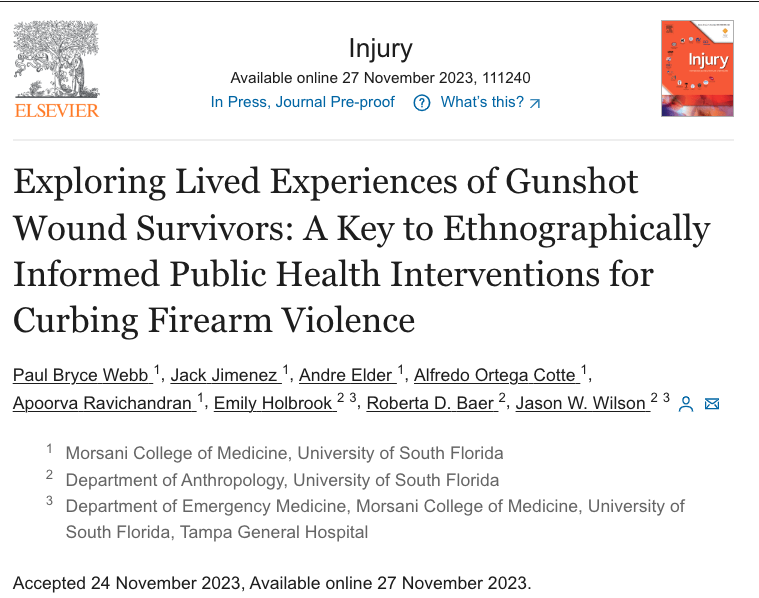
New Publication! Exploring Lived Experiences of Gun Shot Wound Survivors: A Key To Ethnographically Informed Public Health Interventions for Curbing Firearm Violence

Our (JW and RB) students have been interviewing people in the ED who have been shot recently or in the past over the last few years in order to understand lived experiences of those that survived firearm violence with an aim to generate potential interventions to impact this epidemic that is sometimes lost on the radar (burden & opportunities of gunshot wound survival).

Great job to our students for helping us get this manuscript over the finish line – it’s one I am really proud of! Thanks to grad student Emily Holbrook, MA for all of her efforts on this project and with the undergrad & medical students. https://lnkd.in/eW-cttbt

Heat Related Illness Increase in the ER

I enjoyed talking to Bloomberg about some of the heat related issues we have seen during this ongoing climate catastrophe and the highest temperatures ever recorded.

“At Tampa General Hospital, several heat-related cases have been particularly concerning, said emergency-medicine physician Jason Wilson. Some patients had temperatures as high as 107, while others had third-degree burns from lying in the hot sun, which can happen when heat stroke alters a victim’s mental state.

Doctors sometimes take extreme measures in these cases, including implanting tubes that move cold water into a patient’s body, said Wilson, chief of the University of South Florida’s emergency medicine division, which is affiliated with the hospital.”

“While Wilson hasn’t seen the number of patients rise above past years, he said doctors are concerned and keeping an eye on the situation.

It’s “like a shark bite summer,” he said. “You kind of have to wait and see where things fall out.”’

https:/www.bloomberg.com/news/articles/2023-07-21/emergency-rooms-swamped-as-record-100f-heat-wilts-us-south;!!PQLRnUARXRzt!76MVwhF1sN5Pgu6u4spAuIocSyCIZJI_HR-Bg2uXO0NZN1Jm_LAHbEaymmdImZCi_pIZnOxMzv1BOK8pvcVE1w$

USF Clinical Medical Anthropology and Social Medicine at SfAA 2023

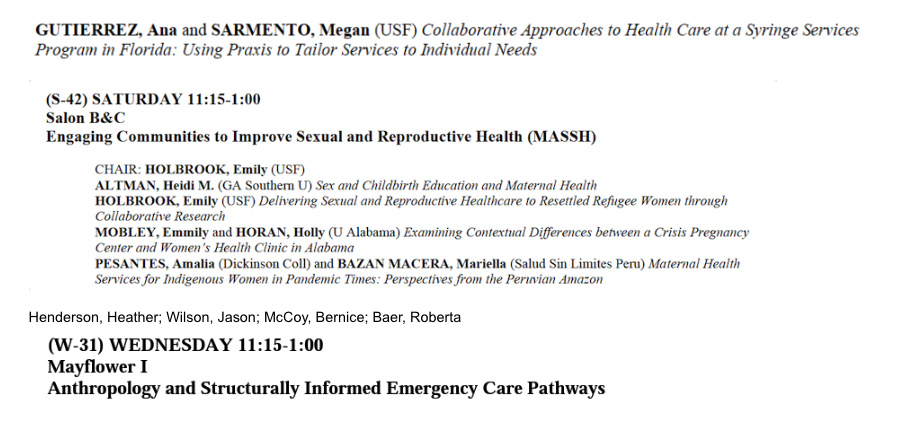
Megan Sarmento (PhD student) and Ana Gutierrez have an on-demand poster that discusses our collaborative, interdisciplinary approaches at the needle exchange. 

Emily Holbrook (PhD candidate) will serve as chair (!) for a panel regarding reproductive health and work on resettled refugee women. 

Heather Henderson, PhD and Jason Wilson, MD (PhD Candidate) will serve as co-chair on a panel with Bernice McCoy, PhD and Roberta Baer, PhD regarding our use of anthropology in clinical spaces to create structurally informed pathways. 

Great work everyone!

For residents, medical students and grad students on this message – we always welcome your involvement in Social EM. Please just reach out!